Why Your Furnace Blower Runs Constantly
You turn the thermostat down, and the heat shuts off, but the fan keeps blowing.
Now you’re standing there wondering, why is my furnace fan always on?
If your furnace blower runs constantly, it doesn’t always mean something is broken. Sometimes it’s a simple setting. Other times, it points to a furnace electrical issue or control problem that needs attention right away.
The important part is figuring out which situation you’re dealing with.

Why Is My Furnace Fan Always Running?
One of the most common winter calls we get from homeowners is this question.
The HVAC fan running nonstop feels like something serious. You hear air moving through the vents even when the house has reached the desired temperature. It can be frustrating, especially at night when you’re trying to sleep.
The good news is that not every time the blower motor keeps running is it a situation where you need emergency service.
Start with the basic checks.
Check the Thermostat First
Before assuming you need furnace repair here in Vancouver, WA, check your thermostat.
Look at the fan setting. Most thermostats have two options: ON or AUTO. Homeowners sometimes describe this as a furnace fan stuck on auto, especially if the fan keeps running even when they think the settings are correct.
If the thermostat fan setting is on vs auto, the blower will run constantly, circulating air 24 hours a day, even when the heat isn’t running.
Switch it to AUTO. In AUTO mode, the blower only runs when the furnace is actively heating.
Smart thermostats can be confusing as well. Some have circulation modes that run the fan for a set number of minutes each hour. Others may have programming glitches that leave the fan active.
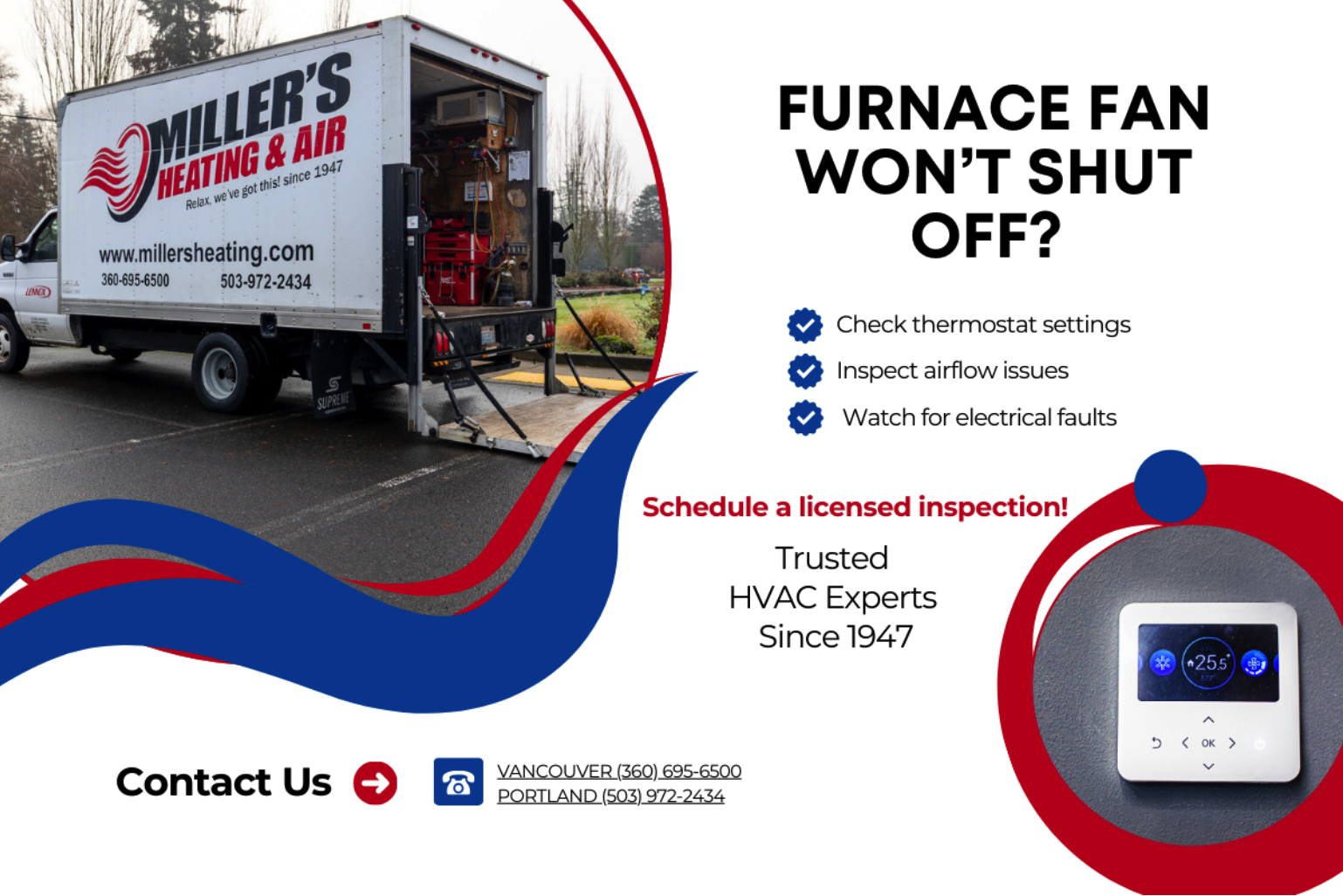
If your furnace fan won’t turn off, always check thermostat settings first.
Electrical or Control Board Causes
If the thermostat looks like it’s working and the blower still runs nonstop, the issue may be electrical.
A stuck relay inside the control board can keep power flowing to the blower motor. When that happens, there aren’t many easy adjustments you can make.
A faulty control board can also send incorrect signals to the blower, and wiring issues inside the furnace cabinet sometimes cause similar symptoms.
These aren’t DIY repairs.
A furnace electrical issue requires knowing how to test components safely. Improper handling can damage the system further.
If the blower motor keeps running no matter what settings you change, professional diagnosis is the next step.
Limit Switch or Safety Control Problems
Sometimes the system runs the blower intentionally.
If the furnace overheats, a safety device called a limit switch activates. When that happens, the burners shut off, but the blower keeps running to cool the heat exchanger.
From the outside, it may look like the furnace is running but not heating.
That usually points to restricted airflow or overheating. If you have a dirty filter, blocked returns, or duct restrictions, it can trap heat inside the system.
A furnace limit switch problem also requires proper diagnosis. You can’t simply reset the system to fix the underlying cause.
If overheating continues, the system may shut down entirely or begin short cycling.
Short Cycling and Airflow Problems
Airflow plays a major role in how the blower behaves.
Dirty filters can restrict airflow, and blocked returns can prevent proper air circulation. If there are restrictions in the duct, it can create pressure buildup.
With less airflow, heat builds up inside the furnace cabinet. The safety controls respond by turning off the burners while keeping the blower running.
If the blower is constantly operating, it signals a larger airflow issue
If your HVAC fan is running nonstop, coinciding with uneven heating or high temperatures near the furnace, airflow may be the culprit.
Replacing the filter is the first step.
When Constant Blower Operation Increases Costs
Even if the system continues heating properly, the fact that your blower is constantly on can increase your utility bills.
Remember, the blower motor uses electricity. You may not notice an increase in your bills immediately, but over time, it adds up.
Continuous operation also increases wear. Motors that run constantly wear out faster.
If the blower motor is tripping the breaker, you might be dealing with electrical overload or motor failure.
What You Can Safely Try
Before calling for help, there are a few things you can check on your own:
Change the air filter if it looks dirty
Adjust your thermostat settings and confirm the fan mode is on AUTO
If the breaker trips, reset it one time. If it trips again, stop and call a technician.
Avoid opening furnace panels or testing internal wiring. Electrical components inside the furnace carry live voltage.
If basic steps don’t resolve the issue, move on to professional service.
When It’s Time to Call a Technician
There are several situations where calling a technician is the safest option, but the situations we most commonly recommend calling in include:
If the blower runs nonstop for days.
If the system overheats or keeps shutting down.
If the breaker trips more than once.
If you suspect you’re dealing with an electrical issue or a control board failure.
In urgent cases, we offer 24-hour HVAC repair in Vancouver.
Preventing Blower Problems
Annual maintenance can reduce most blower-related issues.
When a technician comes out for maintenance, they're checking electrical components to make sure nothing is loose, testing the limit switch to confirm it's responding properly, and seeing how the blower motor is performing under load.
They’ll also look at airflow throughout the system, since restricted ducts or a clogged filter can cause a lot of trouble. It’s much better to find worn wiring or a bad relay that’s on the verge of failing now than dealing with a fan that won't shut off later.
Regular service like this goes a long way toward avoiding unexpected blower issues in the middle of winter.
Frequently Asked Questions
Why won’t my furnace fan turn off?
The most common reason is that the thermostat fan setting is on ON rather than AUTO. If the thermostat is set properly, a stuck relay, faulty control board, or limit switch problem may be the culprit.
Is it bad if the blower runs constantly?
Occasional circulation is fine. But if it's continuously operating for days on end due to a malfunction, it could increase the wear on your system and raise electricity costs.