Most homeowners focus only on the air coming out of the vents. If a room feels too warm or the system seems weak, they usually look at the supply registers first.
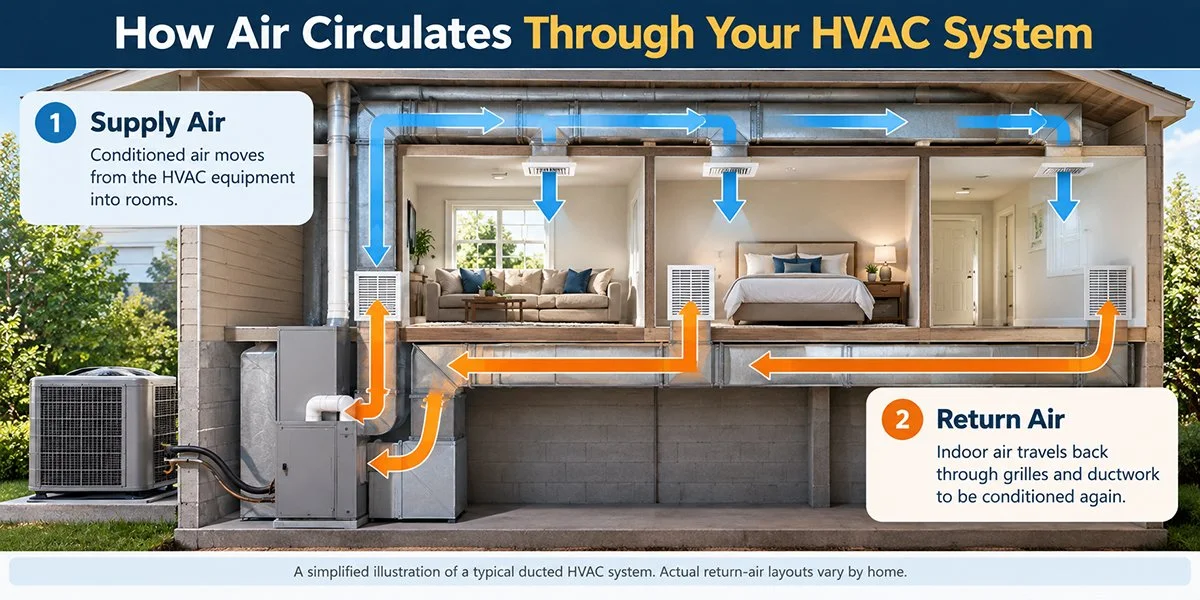
The thing is, your HVAC system also needs a way to pull air back. The supply and return sides work together. Conditioned air enters the rooms through supply vents, then household air travels back to the indoor equipment through return grilles.
If the system can't pull in enough air, it may struggle to maintain proper airflow and keep your home comfortable.
What Is Return Air in an HVAC System?
Return air is the air pulled from your living spaces back toward the HVAC equipment. Return-air grilles are often larger than supply registers and may be located on walls or ceilings, commonly in hallways or central areas of the home.
After conditioned air enters your rooms through supply vents, it circulates through the home and eventually returns through the return grilles and ductwork. The air also passes through a filter, which may be located at a return grille or near the indoor equipment.
The system then conditions the air and circulates it through the home again.
This whole process is a continuous loop.
Unlike supply registers, return grilles usually don’t blow air into the room. You should feel air being drawn inward when the system is running.
Why Your HVAC System Needs Enough Return Air
The blower needs a clear and appropriately sized path to move air through the system. If the return side is blocked or too small, the blower might not be able to pull in the amount of air the equipment was designed to handle.
Restricted return airflow can increase resistance on the return side of the system and reduce the amount of air moving through the equipment and out of the supply vents.
How this affects your home can vary. Your system might run more noisily, or your equipment might run longer to reach the setting on your thermostat. In some cases, it can also affect how well your indoor coil or heat exchanger performs.
Signs Your HVAC System May Not Be Getting Enough Return Air
Several symptoms may point toward a return-air problem:
Dirty Filter: Filters collect dust over time, and a heavily loaded filter can restrict airflow.
High-Efficiency Filters: Some filters create more resistance than the system can accommodate, depending on their design, size, and installation.
Blocked Return Grilles: Furniture, curtains, storage bins, or other household items may partially or completely block a return vent.
Dirty Indoor Coil: A dirty coil can restrict airflow through the equipment, although this isn't specifically a return-duct problem.
Damaged or Undersized Ductwork: Return ducts may be crushed, disconnected, leaking, or too small to deliver the required airflow.
Improper Return-Air Design: Older homes may have return-air systems that aren't adequately sized for newer equipment or changes to the home's layout.
A noisy return grille doesn't automatically mean your return ductwork is undersized. Furniture blocking the grille, a dirty filter, or another airflow restriction may be responsible.
Uneven temperatures may also be caused by poor insulation, supply-side restrictions, or other heating and cooling problems.
What Causes Restricted Return Airflow?
There are a few reasons the return side of your HVAC system might be experiencing problems:
Dirty filter: Filters collect dust over time, and a heavily loaded filter can make it harder for air to pass through.
High-efficiency filters: Some can create more resistance than a system can handle if the filter size, equipment, or ductwork wasn’t selected for that level of filtration.
Blockage: The grille is blocked by furniture, curtains, storage bins, rugs, or other belongings, even partially.
Dirty indoor coil: May become dirty and restrict the air path near the equipment.
Problematic ductwork: Can also be damaged, disconnected, crushed, poorly sealed, or too small for the system.
Improper sizing: In older homes, the return design may not provide enough capacity for a newer or larger HVAC system.
Can Closing Bedroom Doors Affect Return Airflow?
Yes, especially when a bedroom has a supply register but no adequate return-air pathway.
When the supply register sends conditioned air into a room, that air needs somewhere to go when the door is closed. A dedicated return grille can provide that path. Some homes use transfer grilles or door undercuts to allow air to move back toward a central return.
If the pathway is too small or blocked, pressure can build inside the room. You may notice the door moving, air whistling around the edges, or a larger temperature difference between the bedroom and the hallway.
The solution depends on the home’s design. YIn some homes, an appropriately sized door undercut may provide enough airflow. Other homes may need a transfer grille, jumper duct, or dedicated return to maintain proper air circulation when doors are closed. The best way to know is to get an airflow evaluation from a professional.
Can You Have Too Few Return Vents?
The number of return vents doesn’t determine whether a system has enough return capacity. Your home may work fine with a single large central return, and that’s great.
The important factors are:
The size of each grille
The location of the returns
The capacity of the return-air duct
The size and resistance of the filter
The airflow requirements of the HVAC equipment
All of these factors help determine whether the system has enough return-air capacity.
Adding another return air vent may help in some cases, but it isn’t a universal fix.
How HVAC Technicians Check Return-Air Capacity
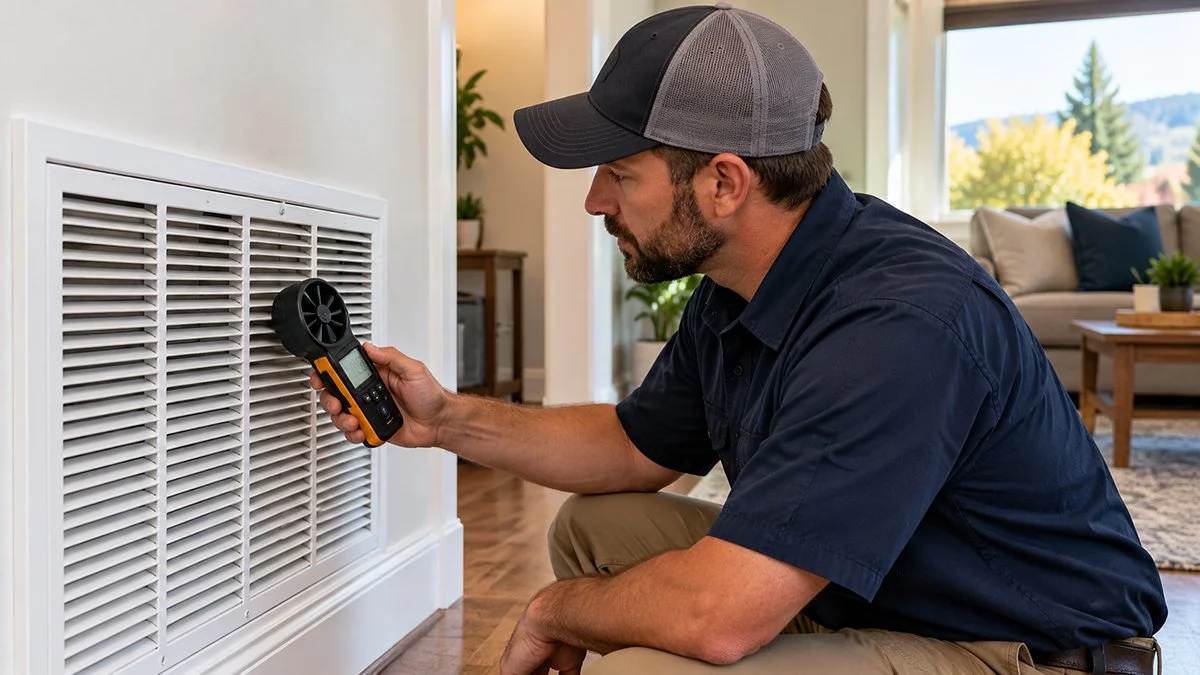
A technician may inspect the return grilles, filter, and visible ductwork for blockages or damage. They may also check whether furniture or household items are limiting airflow at the grille.
Measuring static pressure and airflow, then comparing the results with the equipment manufacturer's specifications, can reveal problems that aren't obvious during a visual inspection. The technician may also inspect accessible return ductwork for restrictions, leaks, disconnected sections, or signs of inadequate capacity.
These checks can show whether the issue is at a grille, in the ductwork, near the equipment, or elsewhere in the system.
Want to know more about the testing process? Read our guide to How HVAC Technicians Diagnose Low Airflow.
Can More Return Air Improve HVAC Performance?
Sometimes, but only if inadequate return capacity is actually contributing to the problem.
Correcting a restricted return-air pathway may reduce airflow resistance, improve system performance, and help maintain more consistent comfort throughout your home. That might mean repairing a damaged return air duct or cleaning a blocked grille.
Adding another return vent isn't always the right solution. You must also look at the size of the ducts, the blower capacity, the requirements of your equipment, and the overall layout.
Don’t Ignore the Air Coming Back to Your HVAC System
The air moving back to the equipment is just as important as the air coming out of the supply vents. If you notice weak airflow, noisy returns, moving doors, uneven temperatures, or unusually long cycles, give the return side a closer look.
Miller's Heating & Air helps homeowners throughout Vancouver, WA, and Clark County identify return-air restrictions and other airflow problems. Our technicians can inspect your equipment and ductwork, take appropriate measurements, and recommend repairs based on what they find.