
Why Your Home Won't Stay Cool During Heatwaves
Some homes handle heatwaves pretty well. Some lose the fight by mid-afternoon.
Even if you have your AC on with the thermostat set low and air coming from the vents, the house might still feel warm and uncomfortable. And if by evening your system is still running and the upstairs bedrooms feel hot, you might be wondering
Why is my house still hot with AC on? Why AC struggles during heatwaves?

During extreme heat, comfort depends on two things working together:
The AC removing heat from the house
The house keeping heat from coming in faster than the system can deal with it.
If that balance gets thrown off, even a working AC can fall behind.
Homeowners often notice the AC running constantly during a heatwave, even though the house never seems to reach the temperature set on the thermostat.
HVAC Systems Have Limits
Your AC is sized to cool your home under normal design conditions.
That means it wasn’t built to make the house feel cold during every possible outdoor temperature. During a heatwave, the outdoor unit has to reject heat into air that’s already very hot. At the same time, the house is gaining more heat through the roof, attic, windows, walls, and air leaks.
So if the AC struggles during a heat wave, it doesn’t automatically mean the system failed. Sometimes the equipment is doing everything it can, but the heat load is higher than usual.
Continuous operation is not always a failure either. On the hottest days, long run times are expected. The system may run for hours because it’s trying to maintain temperature.
The concern is when your HVAC system runs all day but the house never feels cooler or your vents stop blowing cool air.
Attic Heat and Solar Gain
A lot of heat enters from above.
The roof can get extremely hot during a summer afternoon. That heat builds in the attic, then slowly moves downward into the rooms below. If attic insulation is thin or uneven, the upstairs gets hit even harder.
Sun-facing walls and windows take on a lot of heat too. That’s why west-facing rooms are usually the worst because they take on strong afternoon sun right before the house is supposed to start cooling down for the evening.
The same goes for older windows, poor seals, and unshaded glass.
This is one of the most common reasons your house won't cool down even though the AC is running.
You’ll usually feel it most in upstairs bedrooms, bonus rooms, rooms over garages, and spaces with big windows.
Airflow Restrictions Make Things Worse
Your AC needs steady airflow to move heat out of the house. If the filter is dirty, return vents are blocked, or the indoor coil is dirty, the system can’t move enough air across the equipment.
That means certain rooms won’t get cool, and the AC will have to run longer to make up for it.
Also, the outdoor unit has to release heat outside. When the coil is packed with pollen, dust, grass clippings, or other debris, the system has a harder time dumping heat.
During mild weather, you might not feel like these are urgent problems. But dealing with cooling problems during extreme heat is another story.
Refrigerant and Cooling Performance Issues
Refrigerant is what allows the AC to absorb heat inside and move it outside. If the system is low, there is usually a leak somewhere. That means the AC cannot remove heat as well as it should.
Low refrigerant can be the cause of a few things, including:
Longer cooling cycles
Warmer air from the vents
Ice on the refrigerant lines
Frozen indoor coil
The system may keep running, but it won’t cool the house properly.
This can be confusing because the AC might still sound like it’s working, and the outdoor unit may run, but you might not be getting good cooling performance.
Heatwaves put more pressure on the entire cooling process. If refrigerant levels are already off, or if the system has a coil issue, the hotter weather can make it worse.
Ductwork and Air Distribution Problems
If your AC is making cold air but the house isn’t cooling as it should, it may be a leaky duct issue.
Leaky ducts can lose cooled air into attics, crawlspaces, walls, or garages. If your ducts are poorly insulated, they can pick up heat before air reaches the vents. If they’re crushed or too small, they can limit how much airflow is getting to certain rooms.
Every bit of lost airflow can hurt during a heatwave. The system is already under load, so if cooled air is leaking or getting restricted before it reaches the living space, it can make your house a lot less comfortable.
A technician can test airflow and duct performance.
When an Older System Starts Struggling
Over time, your AC system might start to run less efficiently. Your motors will wear, the coils will get dirty, and the compressors won’t work as well as they used to. Even if your system still runs, it may not cool with the same strength it had 10 or 15 years ago, and there’s not much you can do except for swapping out the system.
Capacity can also be a problem if the house has changed. If you’ve added onto the house, converted some spaces, put in new windows, or added insulation, it can impact how well the house cools.
If an older system keeps falling behind, it may need repair, maintenance, or replacement. Note that not every struggling system needs to be replaced right away, but it does need a real evaluation.
What Homeowners Can Check
We always recommend looking at a few things first:
The air filter: If it’s dirty, replace the air filter. A clogged filter can limit airflow through the whole system.
Check the outdoor unit: Clear away leaves, weeds, grass clippings, and anything stored too close to the cabinet.
Look at thermostat settings: Large daytime setbacks can backfire during extreme heat. If the house gets too warm during the day, the AC may spend the rest of the evening trying to catch up.
Check the vents: Make sure supply and return vents aren’t blocked or closed.
These steps won’t fix every issue, but they can rule out simple problems before you call for service.
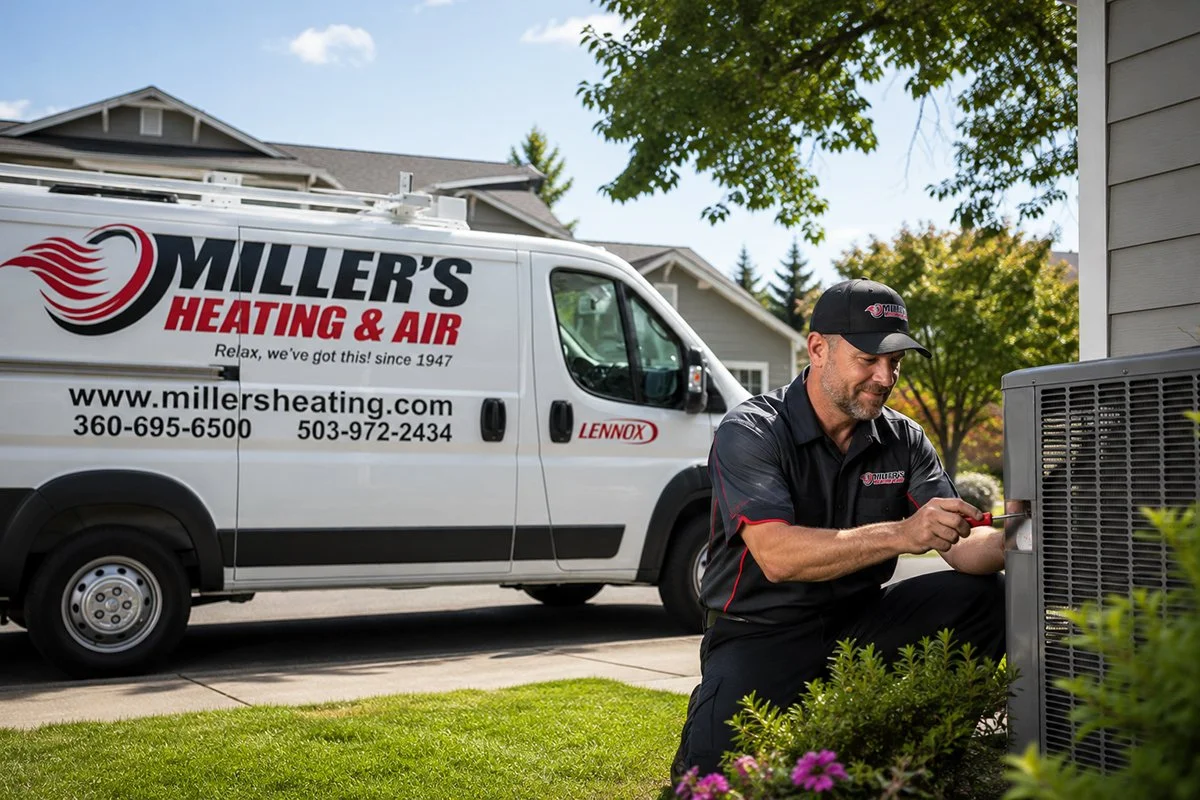
When to Call for Service
Call for service when the system is running constantly, but your home isn’t cool.
Warm air from the vents is a clear warning sign. So are frozen refrigerant lines, ice on the indoor coil, unusual noises, short cycling, or energy bills that jump suddenly without a clear reason.
You should also schedule service if the house stays hot even after basic checks. At that point, the problem may involve refrigerant, airflow, electrical components, dirty coils, duct leakage, or system capacity.
For air conditioning repair in Vancouver, WA, the goal is to figure out whether the AC itself is underperforming or whether the home is gaining heat faster than the system can remove it.
Solve the Real Cooling Problem
Heatwaves expose weaknesses much faster than normal summer weather.
If your home never feels cool during extreme heat, don’t keep lowering the thermostat and hoping it catches up. Call for service and prevent emergency breakdowns while making your home comfortable again.