Mid-Summer HVAC Check for Homeowners
The hottest weeks of summer are typically when the worst AC problems pop up.
It makes sense when you think about it. Your system is running longer, starting more often, and trying to keep up with hotter afternoons, warmer nights, and more heat building up inside the house.
That’s why mid-summer HVAC maintenance is so important. You don’t want to wait until the AC gives out completely before checking how the system is doing. With our simple HVAC maintenance checklist below, you can catch early warning signs of AC performance problems.
Some things are easy for homeowners to check, so we've created this mid-summer HVAC list to look for before problems get worse.
Others need a professional AC system inspection. We’ll break it down for you so you can figure out which is which.
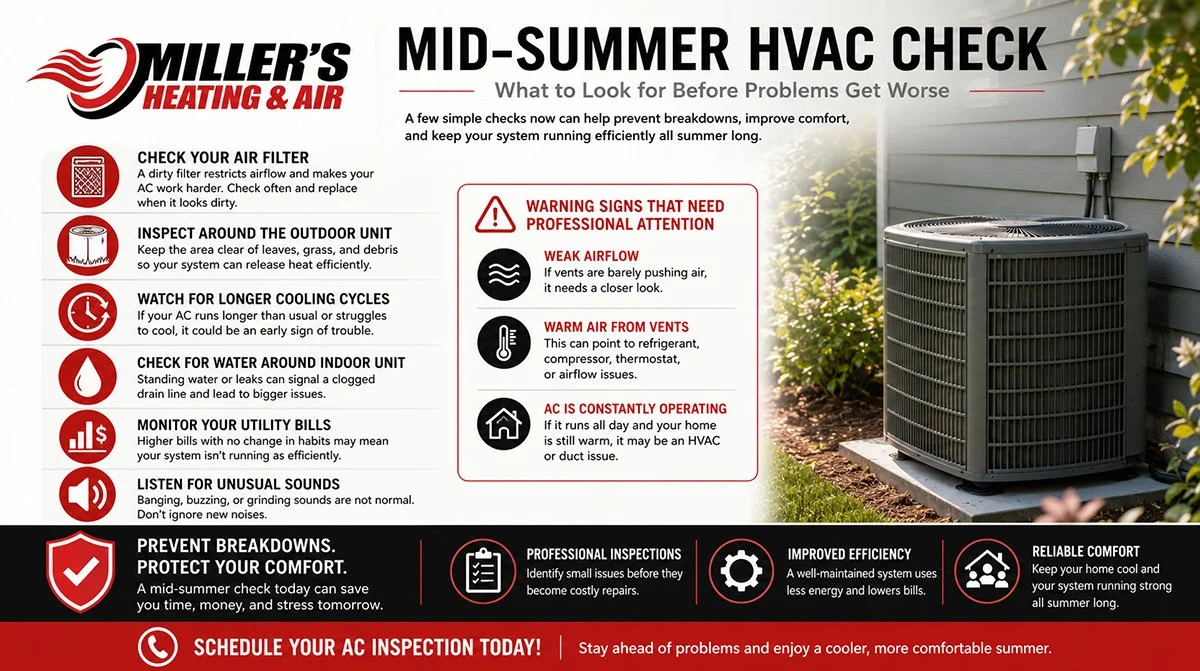
Check Your Air Filter
Always start with the air filter.
It sounds simple, but a dirty filter can cause several problems. When the filter gets packed with dust, pet hair, and debris, the AC has to work harder to pull air through the system. It reduces airflow, increases runtime, and can make certain rooms feel warmer than they should.
If your filter is clogged, it can also make the indoor coil too cold, which raises the risk of it freezing.
During heavy AC season, check the filter more often than the rest of the year. If it looks gray, dusty, or bowed inward, replace it.
Inspect Around the Outdoor Unit
Your outdoor unit needs space to release heat.
That’s its whole job. It pulls heat from inside the house and dumps it outside. If the area around the unit is crowded with weeds, leaves, grass clippings, branches, patio storage, or cottonwood fluff, the system won’t be able to move air through the coil the way it should.
That also means your AC will have to run longer to do the same amount of cooling.
Walk around the unit and look for obvious blockage. Trim back plants, clear away loose debris, and make sure nothing is leaning against the cabinet. Don’t spray high-pressure water into the unit or try to take panels off, but do keep the area open.
Watch for Longer Cooling Cycles
Just because you have a longer cooling cycle doesn’t always mean something is wrong.
When it’s hot outside, your AC is supposed to run longer. That’s normal. The problem is when the system runs much longer than it used to under similar conditions or never really seems to catch up.
If your AC used to cool the house steadily but now runs for hours with little change, that’s an early warning sign. The issue could be several different things, from dirty coils to a lack of refrigerant.
The downside of long cycles is that they increase wear on the compressor and blower motor. They also drive up energy use. So when your AC seems to be working harder every week, don’t shrug it off as just summer being hot. It may be the system telling you it needs service.
Check for Water Around the Indoor Unit
Your AC pulls moisture out of the air as it cools. That moisture drains away through the condensate line. If the drain line clogs, backs up, or disconnects, water can collect around the indoor unit.
Drainage problems are pretty common during cooling season because the system removes more humidity when it runs more often. If water backs up far enough, it can shut the system down or damage nearby materials.
A little condensation in the right place can be normal, but standing water around the unit is not.
Monitor Your Utility Bills
Your energy bill can tell you when the AC is working too hard.
Naturally, your summer bills will be higher. But if your bill jumps more than normal and your habits haven’t changed much, it may be that your AC isn’t running as efficiently.
Maybe airflow is restricted. Maybe the condenser coil is dirty. Maybe the thermostat is off. Maybe the system is running longer because it can’t remove heat very well.
This is when we recommend scheduling air conditioning service in Vancouver, WA. A technician can assess your system performance rather than just guessing from the bill.
Listen for Unusual Sounds
Your AC shouldn't make loud or unusual sounds.
A little startup noise is normal, but not loud grinding, buzzing, rattling, or banging.
Different sounds can mean different things, but they won’t necessarily tell you what’s wrong.
The worst thing you can do is wait to call in a technician to check it out. If it’s a loose part, for example, it can damage other components. Or if the buzzing is coming from a weak electrical part, it could fail completely during the next hot afternoon.
Warning Signs That Need Professional Attention
Some AC symptoms call for professional repair:
Weak airflow: If the vents are barely pushing air, even with a clean filter, the system needs a closer look.
Warm air from the vents: usually points to refrigerant problems, compressor problems, thermostat trouble, or airflow restrictions.
AC is constantly operating: If the AC runs all day and the house still feels warm, it may be an HVAC issue, a duct problem, or something involving insulation.
Benefits of a Professional HVAC Inspection
A professional inspection goes deeper than the things you can see from the outside.
During an AC system inspection, a technician will:
Test electrical components
Check capacitors
Inspect contactors
Look at wiring
Review the thermostat
Measure airflow
Inspect coils
Evaluate refrigerant performance.
Professional maintenance helps identify those problems while there’s still time to address them. If you’re comparing HVAC tune-up specials, make sure the service includes thorough testing, not just a quick filter check.
A good mid-summer visit should give you a better idea of how the system is performing and what you might need to do to keep it that way for the next heatwave.
Stay Ahead of Summer HVAC Problems
Peak summer is a rough time for an AC system to fail. A simple mid-summer inspection can catch small problems before they become expensive repairs or unexpected breakdowns.
Keep an eye on the filter, the outdoor unit, cooling cycles, utility bills, water around the indoor equipment, and any new sounds.
If something feels off, schedule service before the hottest weeks push the system even harder.