Why Your Furnace Takes Too Long to Heat
A slow-to-heat furnace is one of the most common winter complaints we receive at Miller's Heating and Air from Vancouver and Clark County residents. And yes, it can be extremely frustrating.
So, how long should it actually take for your furnace to warm the house? And how do you know when slow heating is just “winter being winter” versus something you actually need to worry about?
Let’s break it all down in a way that makes sense, even if you know nothing about HVAC systems.
Why Understanding Warm-Up Time Matters for Homeowners
Warm-up time probably isn’t something you’re thinking about until your house isn’t heating fast enough. But knowing what’s normal can help you spot problems before your furnace overworks itself and you receive a shocking utility bill in the mail.
A few things affect how quickly your home warms up:
The age of your furnace
The layout of your house
Insulation (or lack of it)
Outdoor temps (Vancouver’s damp cold hits differently)
Furnace size and type
Airflow through your ductwork
Slow furnace heating can absolutely be a sign of poor furnace efficiency in Vancouver, WA, especially if the system is older or hasn’t been serviced in a while.
The big takeaway here is that warm-up time can tell you a lot about how healthy your system actually is.
How Long Should It Actually Take? (General Heating Benchmarks)
A well-functioning furnace should noticeably heat your home within 15–45 minutes. If your furnace warm-up time is consistently longer than that, it may be a sign of airflow, sizing, or efficiency issues.
However, once again, that can depend on the things we listed above.
Some quick benchmarks:
Gas furnaces: Usually the fastest. You should feel warm air in under 10 minutes and solid heat within 20–30 minutes.
Electric furnaces: These heat steadily but more slowly. They don’t “blast” heat the way gas does.
Heat pumps: Efficient yet gentle. Expect a longer warm-up, especially on really cold days.
Vancouver’s damp winters also affect things. The air is cold and wet, which sinks into walls, floors, and furniture. Even if the thermostat says 68°, your home might feel colder, so it takes longer to feel warm.
When is slow heating normal?
Right after you return from vacation
After the thermostat was turned way down
When it’s freezing, windy, or raining sideways
When is it not normal?
No noticeable warmth after 45 minutes
Some rooms heat and others don’t
Warm air is super weak
The furnace cycles constantly but never catches up
You have to keep bumping the thermostat up
If that sounds like your situation, keep reading.
Common Reasons Your Furnace Takes Too Long to Heat the House
This is where most homeowners start to figure things out. Slow heating almost always comes back to one of these issues:
1. Dirty or Clogged Air Filters
This is the #1 cause of a furnace taking too long to heat. It also happens to be the easiest to fix.
A clogged filter chokes airflow, which means:
The air doesn’t come out of your vents as powerfully
Your home heats unevenly
The system runs longer than it should
Your furnace takes forever to warm up
If your filter looks dusty, swap it out. You’d be amazed at how much faster your home heats after a fresh filter.
2. Ductwork Leaks or Blockages
Leak in your ductwork? Congrats, you’re warming up your attic or crawlspace for free.
This is extremely common in older homes. Even a small tear can dump a ton of warm air before it ever reaches the bedrooms or the living room.
Blocked or crushed ducts have the same issue.
Getting your ducts inspected or cleaned can make a huge difference, especially for anyone dealing with uneven heating in the house.
3. Thermostat Problems
Sometimes, it’s just the thermostat.
You might place it near a window or heat source, misread the temperature in your home, or have loose wiring. Other times, it’s just an old unit that isn’t very accurate.
If your furnace runs forever and still doesn’t reach the temp you set, your thermostat might be lying to you.
Smart thermostats are a fantastic upgrade here.
4. Undersized or Aging Furnace
Here’s a tough pill to swallow. Sometimes, the furnace just isn’t strong enough for the space.
Older systems lose power as parts wear down. An undersized furnace will run nonstop on cold days and still struggle to keep up.
If your furnace is 15–20 years old, slow heating might just be a sign it’s reaching the end of its life.
5. Low Blower Performance or Mechanical Issues
If the air coming from your vents is barely pushing out, that’s a blower problem. Look out for weak airflow, weird rattling or squeaking noises, vibration, or a burning smell (in which case, shut it off immediately)
A failing blower results in slower heating and higher energy use, which is a lose-lose.
How Vancouver’s Climate Impacts Heat-Up Time
If you’re new to the Pacific Northwest, let us explain a fun little fact:
Our cold feels colder.
The dampness in the air makes heat loss happen way faster. Cold air lingers, sinks into walls, and sticks to floors. Homes with older insulation or original windows have a tough time retaining heat.
This is why furnace efficiency in Vancouver, WA, matters so much. Even a slightly inefficient furnace can struggle in this climate. Keeping your system tuned up is one of the best ways to fight the cold efficiently.
When Slow Heating Means It’s Time to Call for Help
Sometimes slow heating is just a comfort issue. Other times, it’s a sign your furnace needs attention ASAP.
Here are a few red flags you should never ignore:
No warm air after 45 minutes
Rooms never reach the set temperature
Your furnace keeps clicking on and off
You smell burning or something electrical
Your winter energy bill is higher than usual
If you’re seeing any of these signs, it might be time to schedule heating service in Vancouver, WA.
How a Professional Can Improve Heat-Up Time
A good HVAC tech will run tests to see what’s wrong, rather than guessing.
System Diagnostics
Airflow measurement
Temperature rise testing
Heat exchanger evaluation
Checking for blockages or faulty sensors
These tests tell us exactly where your furnace is struggling.
Cleaning & Tune-Ups
A yearly tune-up can massively improve furnace efficiency. It usually includes:
Burner cleaning
Blower cleaning and adjustments
Lubrication of moving parts
Duct inspections
Safety checks
A clean system warms faster, uses less energy, and lasts longer.
Upgrades That Improve Heating Speed
If your furnace is older or struggling, a few upgrades can make a huge difference:
Smart thermostats
High-efficiency furnace models
Duct sealing or insulation improvements
These upgrades help your system heat faster and keep the warm air where it belongs.
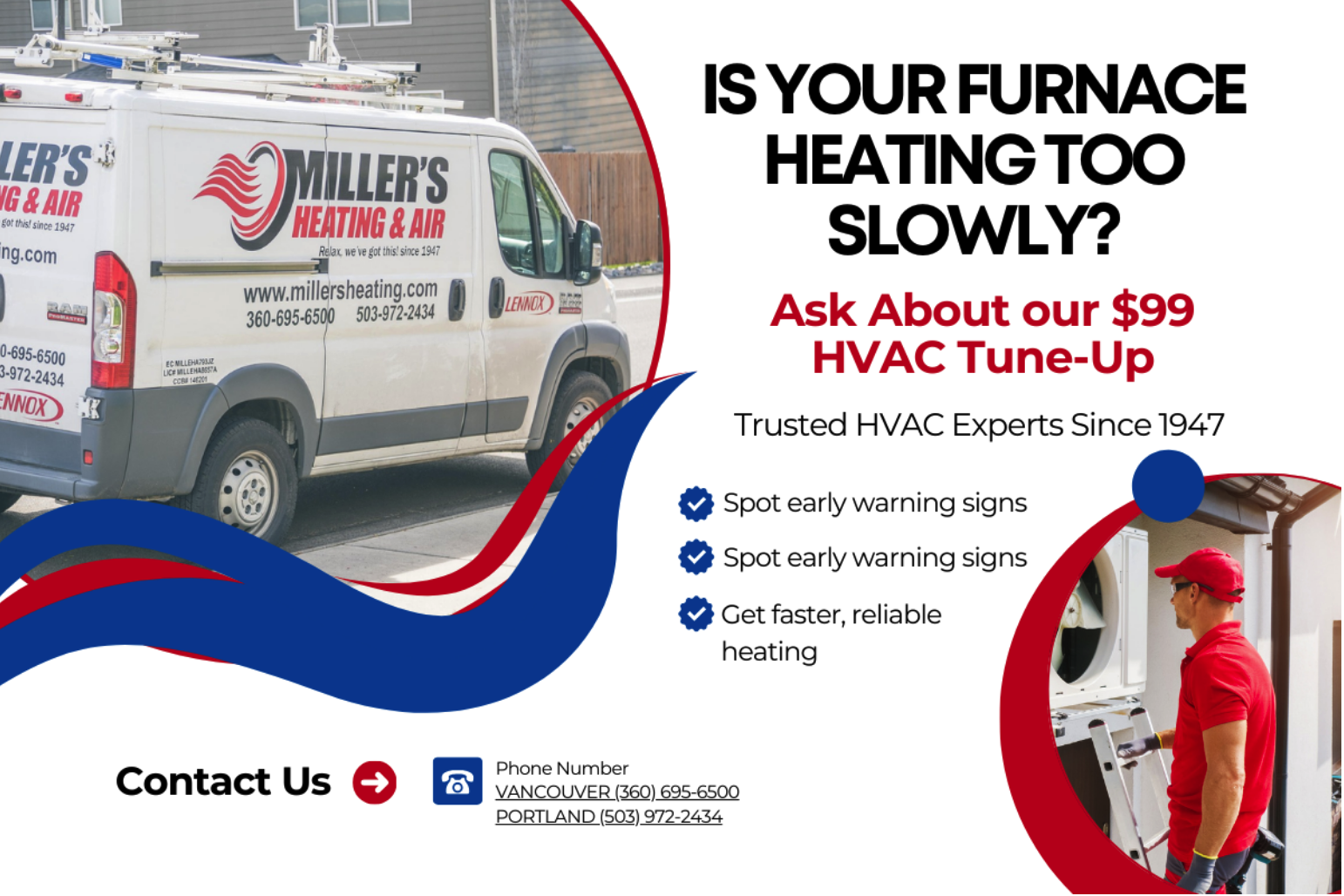
Why Homeowners Trust Miller’s for Faster, More Efficient Heating
There’s a reason why people in Vancouver and Clark County keep coming back to Miller’s when their heat starts acting up. Our technicians actually live and work in the Pacific Northwest. They understand exactly how local weather affects your furnace and why damp cold makes heating systems work harder. We focus heavily on long-term furnace efficiency instead of quick fixes, and we’re honest about what you actually need.
We’ll never try to upsell you or sell you something you don’t need.
When something’s wrong, we move fast. Our team handles diagnostics quickly, gets repairs done the same day whenever possible, and stays available 24/7 for the emergencies that always seem to happen at the worst time.
Miller’s has been helping local homeowners stay warm since 1947, and at this point, we’ve seen pretty much every furnace issue you can imagine.
Don’t Wait for Slow Heating to Get Worse
A slow furnace is often a sign of something deeper going on. Ignore it, and you could end up spending way more on bills than you need to or paying for huge repairs.
If your furnace is dragging its feet, schedule heating service in Vancouver, WA, with Miller’s. A quick check or regular maintenance can save you from a whole lot of money, stress, and cold mornings.